Beginner Drawing Exercises
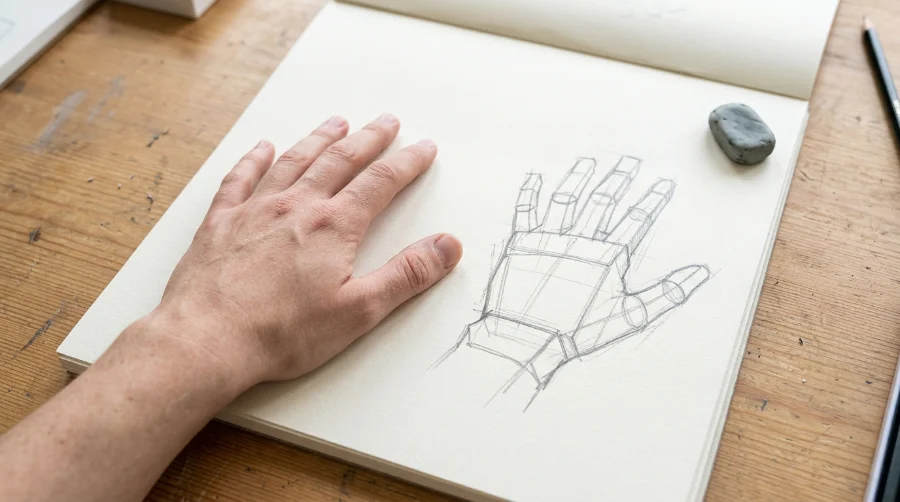
A Beginner's Approach to Drawing Hands
Almost every drawer avoids hands. They are complicated, they move constantly, they are often the first thing a viewer looks at, and getting one wrong makes an…
Ten minutes is long enough to make a real drawing and short enough that you will actually do it. That combination is why timed sketching is the most reliable…
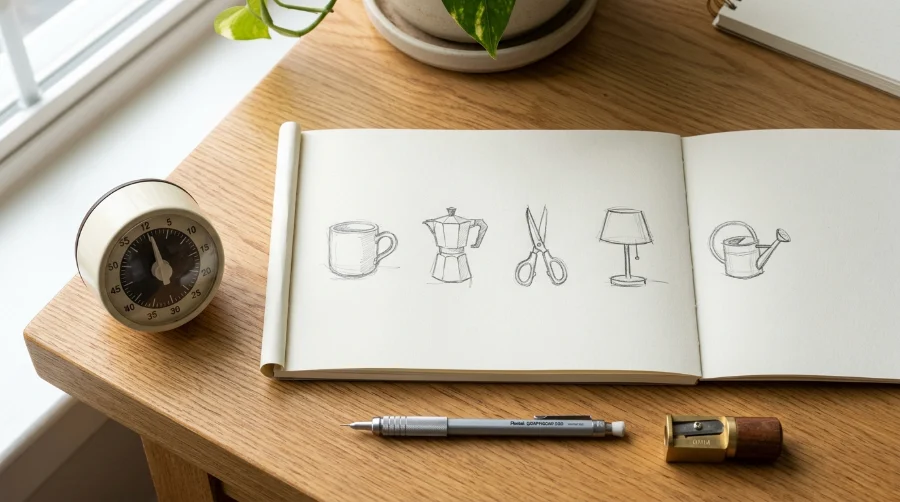
Ten minutes is long enough to make a real drawing and short enough that you will actually do it. That combination is why timed sketching is the most reliable practice format for beginners, and why it works better than long sessions once you have the basics down.
The format only works if you set up the session in advance. Ten minutes spent deciding what to draw is ten minutes of not drawing.
The rule that matters most is that the timer does not stop. If you have made a mistake, you correct it and continue. If you have five minutes left, you make a decision rather than starting a second drawing.
Beginners tend to spend the whole session on the first two minutes of looking, then panic. Writing the schedule down before the timer starts removes that problem.
Not every subject is equally useful for a timed session.
A useful rule for a daily practice is to rotate subjects so that you are always practicing something you are weak at, rather than drawing the same comfortable object every day.
A ten minute drawing is not finished when the timer stops. There is a short second stage that makes the practice worth doing.
Doing this consistently builds something no amount of copying exercises builds, which is an accurate sense of what you actually do wrong. Artists who skip this stage usually improve at drawing things and never improve at seeing.
Ten minutes disappears quickly, and beginners frequently spend it on a single object rather than on the whole composition. A reliable way to avoid that is to divide the subject in advance.
When you are short of time, drawing what you see as blocks of light and shadow is faster and more effective than drawing recognizable things.
This approach is also more forgiving, because a drawing built on value has a solid structure even if some of the objects are wrong.
The main obstacle is the belief that ten minutes is too short to do anything worthwhile. It is long enough to make a drawing you would be glad to keep, and the constraint removes the option of overworking, which is one of the hardest habits to break on your own.
The reason a short session beats a long one for most beginners is that the long session spends most of its energy on decisions about what to keep, and those decisions are made after the interesting part of the drawing is already over. A fixed time forces the choices to be made before the timer starts, and the drawing gets finished while the attention is still there.
Ten minutes a day adds up to more drawing than most people do in a month of longer sessions, and it does something longer sessions cannot, which is build the habit of starting. Starting is the part that actually needs training.
Lessons that pair well with this one.
Almost every drawer avoids hands. They are complicated, they move constantly, they are often the first thing a viewer looks at, and getting one wrong makes an…
Most people who want to learn to draw do not have a motivation problem. They have a problem with not knowing what to do once they sit down with a pencil. Ten…
Copying a drawing by a master artist is the most efficient study method most beginners never use, and the reason is that it has to be done in a specific way to…