Art Fundamentals
Choosing a Viewpoint and Drawing One Subject From Many Angles
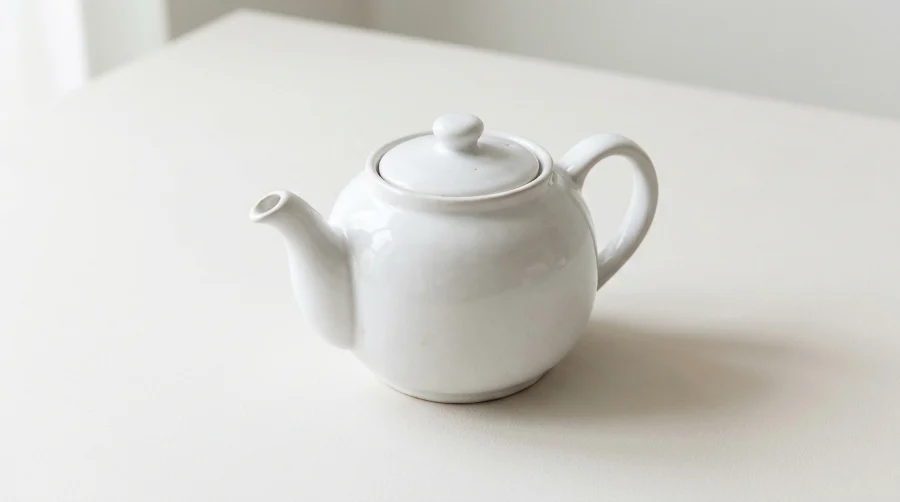
Most people draw the same subject the same way for years without noticing. They sit in front of it, they draw what they see, and they never find out what it looks…
Anatomy is not the memorization of muscle names. It is a working knowledge of how the body is put together, and it only needs to be good enough to get a drawing…
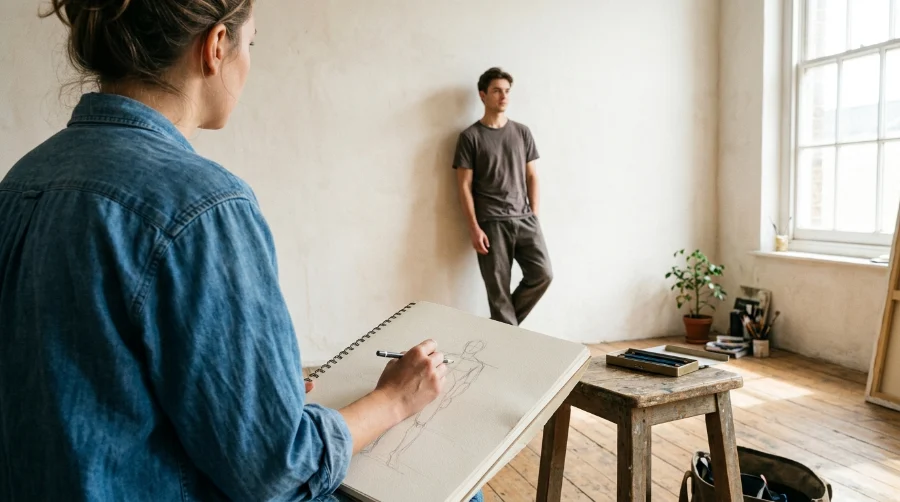
Anatomy is not the memorization of muscle names. It is a working knowledge of how the body is put together, and it only needs to be good enough to get a drawing right. Most beginners need a handful of proportions, a few structural facts, and a way to check their work, not an anatomy textbook.
This checklist is that starting point. It is designed for someone drawing people they know, in ordinary poses, in ordinary clothes, which is what most drawing actually involves.
Decide up front whether you are drawing a portrait, a figure, or a gesture. Each needs a different amount of information.
Beginners often try to make a portrait carry the full weight of a figure drawing. Deciding which one you are doing removes a lot of wasted effort.
These are averages, and real people vary, but they give you a starting point to adjust from.
Measure these against the head, since the head is the unit that is always on the drawing.
Whatever the pose, you should be able to find these five points and connect them into a simple stick figure in under a minute.
That last point is the one that separates a figure that stands from one that looks like a paper doll leaning over. If the vertical from the neck falls outside the feet, the pose needs adjusting, or the figure needs a support such as a chair or a wall.
Weight-bearing feet are flat and point where the body's weight is going. A foot that is fully flat on the ground is taking weight.
The other foot may be on its toes, tilted, or lifted. A raised heel tells you immediately that the weight is on the other side.
The tilt of the pelvis and shoulders usually go in opposite directions when a person is standing casually. If the hips tilt up on the left, the shoulders tend to tilt down on the left. This is what makes a standing figure look relaxed rather than stiff.
Arms hang from the shoulder joint, not from the neck. When an arm lifts, the whole shoulder structure changes, and the space between the arm and the rib cage opens up.
For a portrait, work from the skull rather than from the features. The skull is an egg shape, narrower at the jaw, and the features sit on a face plane that is tilted relative to the front of the skull.
The key lines to place first are the center line down the face, the brow line, the base of the nose, and the line of the jaw and chin. These four lines describe the structure of the face far more efficiently than any amount of shading.
Then place the eyes on the brow-to-base-of-nose line, halfway down the head, with the pupils roughly at the midpoint of the head's width. The corners of the mouth sit about halfway between the base of the nose and the chin. These are averages and they are enough to get a likeness close enough to refine.
Hands and feet cause more frustration than any other part of the body, and the reason is that people draw them before they are ready. A useful compromise is to draw them as a simplified mass with a clear gesture for the fingers, and to add the individual digits only in the areas that matter.
For a hand, the block is a wedge for the palm with a thicker mass where the thumb attaches. The fingers are drawn as tapered cylinders that get shorter from index to little finger, and they are separated only at the tips, since the bases of the fingers merge into the palm.
For a foot, start with a wedge and note the arch on the inner side. The big toe is the largest digit and the others step down in a smooth curve. Ankles are narrow compared to the calf, which is one of the most common beginner errors.
Working in this order means the errors get caught early, when they are cheap to fix. Anatomy is a set of checkable facts, and a checklist only helps if you actually use it, so keep the list nearby while you draw and run through it every time.
Lessons that pair well with this one.
Most people draw the same subject the same way for years without noticing. They sit in front of it, they draw what they see, and they never find out what it looks…
A sphere drawn with a gradient from light to dark reads as a flat disc with a smudge on it. The same sphere drawn with a light source in mind reads as a ball. The…
The most common way a beginner's drawing goes wrong is not in the detail. It is in the fact that the objects look flat. A mug is drawn as an outline of a mug. A box…