Drawing Basics
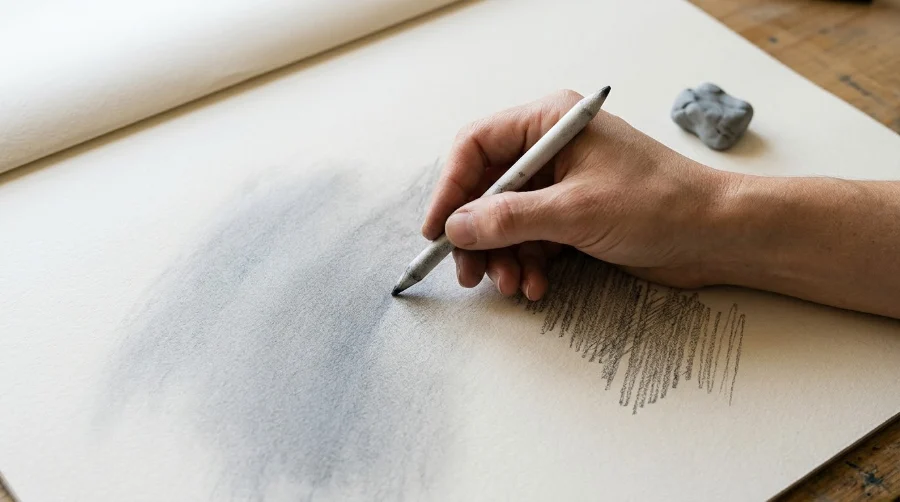
Blending Graphite for Smooth Gradients and Soft Edges
Graphite is the most forgiving medium in drawing, and one of the most poorly understood. Beginners tend to treat the full range of the pencil as a set of seven or…
Most people who learn to draw are told to look carefully, and the advice is correct. It is also incomplete. Observation training sharpens the eye, but observation…

Most people who learn to draw are told to look carefully, and the advice is correct. It is also incomplete. Observation training sharpens the eye, but observation alone has a ceiling, because it trains the ability to reproduce what is in front of you rather than the ability to hold an image in the mind and reconstruct it. Both abilities are needed, and they are trained in different ways.
Understanding the difference between the two modes is one of the most practical changes a developing artist can make, because it changes how you practice.
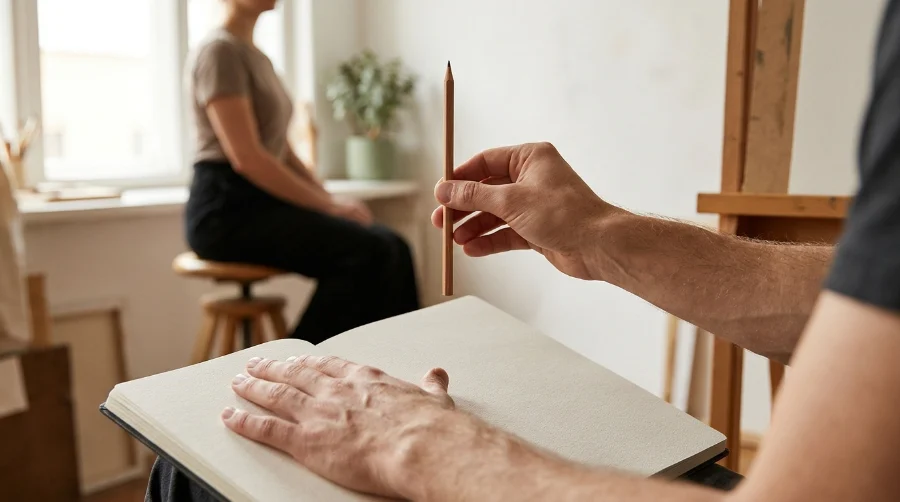
Observation drawing is drawing with the subject in front of you and your eyes moving back and forth between the subject and the page. The eye gathers information in fragments: the length of an edge, the angle of a shadow, the spacing between two shapes. The hand assembles those fragments.
This trains several things at once. It trains accuracy of proportion, because you are constantly comparing lengths against each other. It trains edge perception, because you are learning where one boundary ends and another begins. And it trains the habit of checking your work against reality instead of against your memory of reality, which is the more reliable check for a beginner.
The weakness of pure observation work is that it teaches you to draw what is in front of you and nothing else. This becomes obvious when you try to draw a familiar chair and it collapses into a generic chair, or when you draw a friend's face and the likeness is weak even though you were looking directly at them. Observed detail and remembered structure are different things, and one does not automatically produce the other.
Memory drawing is drawing without the subject present. It is used constantly in real work: an illustrator draws a person from memory on the train, a designer sketches a product after a meeting, a painter blocks in a landscape on the spot and finishes it later.
Training memory has clear benefits. It forces you to make decisions rather than measurements, which means you learn to simplify. It exposes gaps in your understanding, because a chair you cannot draw from memory is a chair whose structure you have been copying rather than learning. And it builds the ability to work at speed, which changes how much you can finish in a session.
The weakness of memory work is accuracy of proportion. Remembered shapes drift toward the average of everything you have seen, so familiar objects need to be checked against a reference more often than you would like.
Professional illustrators work in a cycle between the two modes.
Step two is where most beginners skip ahead. They observe and then copy, and the copy looks accurate but does not stick, because nothing was encoded. The point of memory work is not to produce a good drawing from memory immediately. It is to force you to encode.
Choose subjects with structure rather than subjects with detail. A folded chair, a toolbox, a bicycle, and a stack of books teach proportion better than a face does, because they are made of straight edges and simple volumes that can be checked.
Memory work gets easier with repetition of specific subjects, not with general practice. Twenty drawings of one chair over two weeks will teach you more about chair construction than twenty drawings of twenty different chairs.
A simple weekly pattern works well. Spend one session on careful observation of a single structured subject. Spend the next session on memory drawings of the same subject, then compare. Spend the third on a subject you dislike, which is where your habits are most visible. Over a month, the comparison between the observation sheet and the memory sheet tells you more about your own progress than any finished drawing will.
The goal is not to choose between looking and remembering. It is to be able to move between them deliberately, using observation when accuracy matters and memory when speed, understanding, or invention matters.
Lessons that pair well with this one.
Graphite is the most forgiving medium in drawing, and one of the most poorly understood. Beginners tend to treat the full range of the pencil as a set of seven or…
Almost every drawing that looks wrong looks wrong in the same way. A head ends up too small for the body, a mug looks squat, a chair ends up with legs of unequal…
Two drawings can describe the same object with the same accuracy and feel completely different. One of them feels calm, the other feels tense. The difference…