Drawing Basics
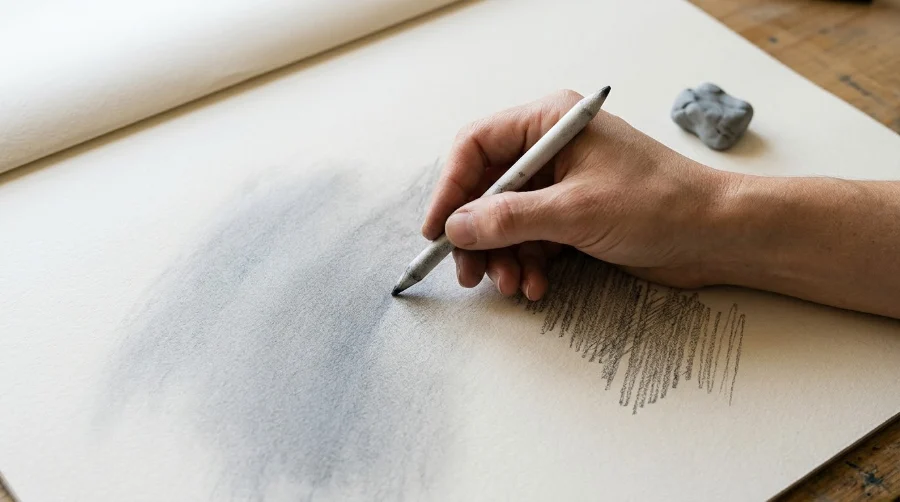
Blending Graphite for Smooth Gradients and Soft Edges
Graphite is the most forgiving medium in drawing, and one of the most poorly understood. Beginners tend to treat the full range of the pencil as a set of seven or…
Symmetry is one of those subjects that sounds easy and is not, because the temptation is to draw one half and assume the other half will follow. It will not…
Symmetry is one of those subjects that sounds easy and is not, because the temptation is to draw one half and assume the other half will follow. It will not. Reflection is a physical event that happens in space, and it introduces everything the drawing world calls the reflected image problem.
Reflections are also one of the most useful things a drawing student can practice, because they force accuracy. A slightly wrong line in a mirrored or reflected form is immediately obvious in a way it never is in an ordinary drawing.
Symmetry means the two halves of an object are the same by construction. A butterfly, a mask, a pair of scissors, a leaf. The axis of symmetry is fixed and the halves are genuinely identical.
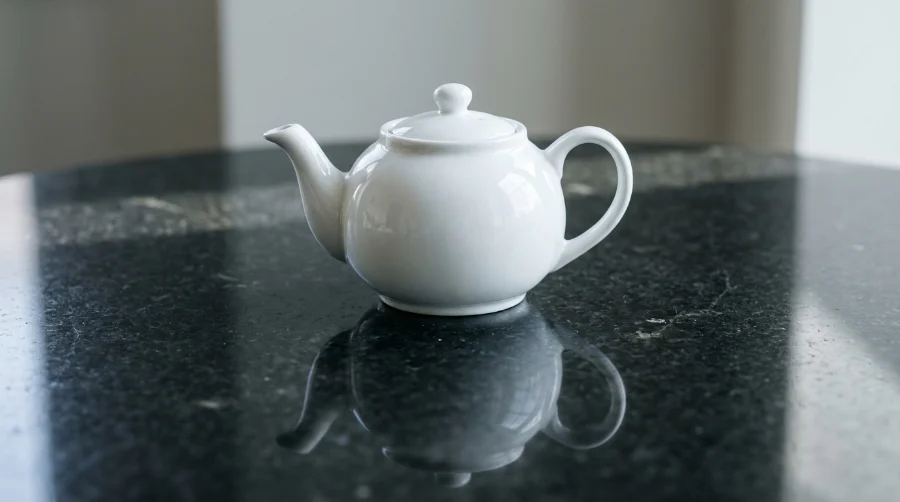
Reflection means one object produces an image of itself. A still life reflected in a polished table, a building in a puddle, a face in a mirror, a tree in calm water. Here the image is a separate thing, distorted by the surface it appears on.
Both are worth drawing, and they fail in different ways, so it helps to keep them apart in your mind.
The traditional method for drawing a symmetrical object is to fold the paper in half, draw half the form along the fold, and then open the paper and trace the other side. This guarantees accuracy and it guarantees a flat, lifeless result, because a real symmetrical object is rarely seen perfectly straight on.
A better approach uses the fold as a guide rather than a template.
Most of the imbalance in symmetrical drawings comes from a difference in viewpoint. When you look at a butterfly held in front of you at a slight angle, one wing is closer and appears larger. Copying the near wing exactly onto the far side produces a drawing of an imaginary object rather than the one in your hand.
This is the point most exercises miss. A symmetrical object seen from anywhere other than dead center is drawn in perspective, and its two halves are not the same size on the page.
Getting this right is what separates a drawing of a symmetrical object from a drawing of a flat diagram. Working out where the axis of symmetry actually sits in the picture plane is the whole task.
A reflection in a horizontal surface is a vertical flip. Everything about the image is inverted: what was high is now low, and what was nearer the bottom of the object is now nearer the top of the reflection.
The important consequence is that the reflection of an object standing on a surface begins at the point where the object touches that surface, and grows downward. It is not a separate copy placed underneath. It is a mirror image hinged at the contact line.
That means the highest part of the object appears at the very bottom of its reflection, and the closest part of the object to the surface appears at the top of the reflection, closest to the viewer. Beginners almost always get this backwards.
There is a second rule that catches everyone. The reflection is only as sharp as the surface allows.
A reflection does not need to be drawn in full. In a painting or a finished drawing, the reflection is usually visible only in patches, because the surface interrupts it. This is a gift, because it means you can choose which parts of the mirrored image to include.
A workable procedure for a still life with a reflective base:
This approach is faster than mirroring the whole object and it looks considerably better, because a partially visible reflection reads as a reflection, whereas a complete one reads as a second object.
Drawing a face in a mirror reverses everything, and most people find it disorienting enough that they avoid the exercise. That is exactly why it is useful.
The procedure is simple. Sketch the face quickly from memory, in a few loose lines, and then draw the mirrored version of that sketch beside it. Comparing the two instantly shows you which features you have been misremembering, because the two versions cannot both be right and the mismatch reveals the error.
Common errors this exposes: the tilt of the head, the relative height of the eyebrows, the shape of the nose, the line of the jaw, and the level of the eyes. Almost everyone has a slightly different mental image of their own face, and this exercise finds it.
Symmetry teaches proportion, because the two halves act as a built-in check on each other. Reflection teaches value and edge, because the mirrored image tells you directly how light and darkness should behave. Both are worth the extra trouble they cause.
Lessons that pair well with this one.
Graphite is the most forgiving medium in drawing, and one of the most poorly understood. Beginners tend to treat the full range of the pencil as a set of seven or…
Almost every drawing that looks wrong looks wrong in the same way. A head ends up too small for the body, a mug looks squat, a chair ends up with legs of unequal…
Two drawings can describe the same object with the same accuracy and feel completely different. One of them feels calm, the other feels tense. The difference…