Drawing from a train, a bus, or a car is a specific kind of challenge, and the difficulty is almost never artistic. It is physical. The paper shakes, the subject…
S SolvaHub Studio EditorsPublished January 6, 20265 min read1,045 words
Sketching from a Moving Vehicle — the idea behind the technique, and where beginners usually go wrong.
Drawing from a train, a bus, or a car is a specific kind of challenge, and the difficulty is almost never artistic. It is physical. The paper shakes, the subject moves, and you cannot look at the page without losing the subject entirely.
The techniques that make vehicle sketching work are mostly about managing those three problems, and they transfer directly to any situation where you have very little time.
Setting up before you move
Everything you do before the journey starts makes the sketch easier.
Choose a rigid support. A clipboard, a sketchbook with a firm back, or a book held against a bag is worth more than any technique. A loose pad on your lap will move with the vehicle and your line will move with it.
Rest your drawing arm. Elbow on the armrest or on the window ledge, wrist anchored lightly on the sketchbook. Some artists hold the paper with the non drawing hand and rest the drawing elbow against it.
Keep the material minimal. One pencil or pen, a small book, and an eraser for a graphite sketch. Every additional item is something you have to manage with a hand that is not steady.
Fix the page. Loose sheets blow away. Work in a bound sketchbook or clip pages together.
Dealing with the shaking page
There are three ways to handle movement, and they work in different situations.
Brace against the vehicle. The simplest and best. Rest your elbow or the edge of the book against the window frame or the door. The vehicle's vibration passes through you and into the paper equally, so relative motion is much smaller.
Move with the vehicle. A trick used by people drawing on trains: let your whole arm swing with the motion of the carriage so that your hand is relatively still in space while the subject moves across it. It feels awkward and it works surprisingly well after a few attempts.
Accept the wobble and use it. In a fast sketch, a slightly shaky line reads as energy rather than error. Many travel sketchers deliberately loosen their grip for speed.
What does not work is trying to draw a smooth slow line while your body is being vibrated. If you need a controlled line, wait for a stop.
Managing the subject
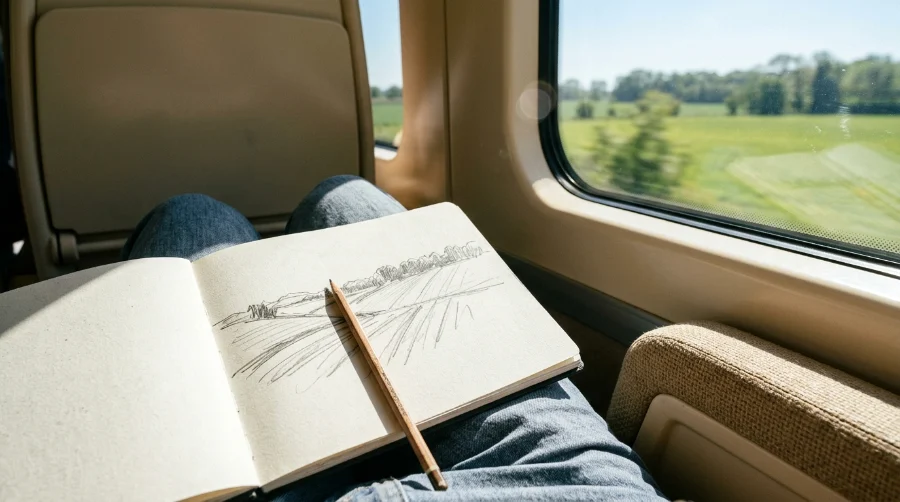
A landscape passing by gives you two or three seconds of stable information before everything shifts. The practical response is to draw what stays constant.
Draw the horizon and the broad mass first. Hills, water, and sky hold their position for longer than a tree or a house.
Capture the large shapes of the near foreground as they pass, using a quick sweeping stroke. They blur into streaks and this is fine.
Do not chase detail. A single tree drawn in ten seconds will be a mess and will not add anything. Three lines that suggest a group of trees will read correctly.
Use the spaces between stops. A train journey gives you several stationary periods. Treat the moving sketches as notes and produce the finished drawing later, using the notes as the raw material.
The habit of treating a sketch as a set of notes rather than a finished piece is what makes travel sketching sustainable. Many otherwise good sketches fall apart because the artist tried to complete the whole scene before the subject left the window.
Working from a car
A car gives you more control than a train but a narrower view, and the vibration is stronger because you are closer to the road.
Draw between towns rather than during them. Open landscape is easier than buildings, which pass quickly and require constant scaling.
Use the side mirror. The reflection in a mirror moves slowly relative to the car, so it gives you longer access to a subject.
Sketch the roadside geometry. Fence lines, telegraph poles, and hedgerows converge toward a vanishing point and are easy to record quickly.
Stop when the view matters. A safe pull off for two minutes produces a better sketch than five minutes of drawing while the car is moving.
Working from a train or bus
Elevated views and passing buildings make trains the best platform for urban sketching.
Upper deck and window seats give you a better angle on rooftops and a steadier horizon.
Buildings pass slowly enough that a simple block-in of a facade, with two or three windows, is achievable.
Bridge and tunnel sequences give you abrupt light changes that are interesting to record and very difficult to draw, which is exactly the point of practising.
Long open stretches are best spent making notes on shape and value rather than detail.
Passing buildings are also a good exercise in simplification, because you cannot draw them accurately anyway. This constraint is useful. It forces the kind of bold, blocky interpretation that reads well at a distance.
Common mistakes
Drawing on a lap with no support. Every line will wander.
Looking at the page too often. In a moving vehicle the subject leaves the window the moment you look down, so memorize the last thing you saw and draw it from memory.
Starting with detail. A fence post drawn in detail while the rest of the scene is empty reads as a mistake.
Trying to finish. Leave pages unfinished and complete them later if you want to.
Choosing a bad seat. A window on the sunny side is often harder to see into, and glare on the glass can make the whole view unreadable.
Drawing while the vehicle turns sharply. Wait for the straight sections.
Short exercises
Ten second marks. While a vehicle is moving, draw ten separate ten second marks of whatever passes. No finishing touches.
One continuous line. Draw a whole passing scene in a single line without lifting the pencil.
Value and shape only. For one minute, record only the dark masses and the horizon.
Post journey reconstruction. From your notes, draw the scene properly at a table.
Vehicle sketching develops a valuable skill: drawing decisively under pressure. In a studio you can always slow down, and slowing down is a habit that can quietly damage your directness. Twenty minutes on a moving train will teach you more about committing to a mark than twenty hours at a desk.
S
SolvaHub Studio Editors
We teach drawing and painting from the ground up — line and shape, perspective and value, color and pigment, and the practice that turns all of it into skill. Every lesson is written around a real difficulty, tested on real materials, and edited for clarity before it goes live. If something here helps, the contact page is the fastest way to tell us.
A landscape is the hardest subject to draw from life and the easiest to draw badly. The reason is that a real landscape contains an enormous amount of information…
Interior sketching has a reputation for being difficult because rooms have a lot of straight lines that all need to meet properly. That is true, and the difficulty…
Drawing strangers is the part of figure drawing that beginners put off longest, usually because they imagine the people they draw will notice, react, or mind. In…