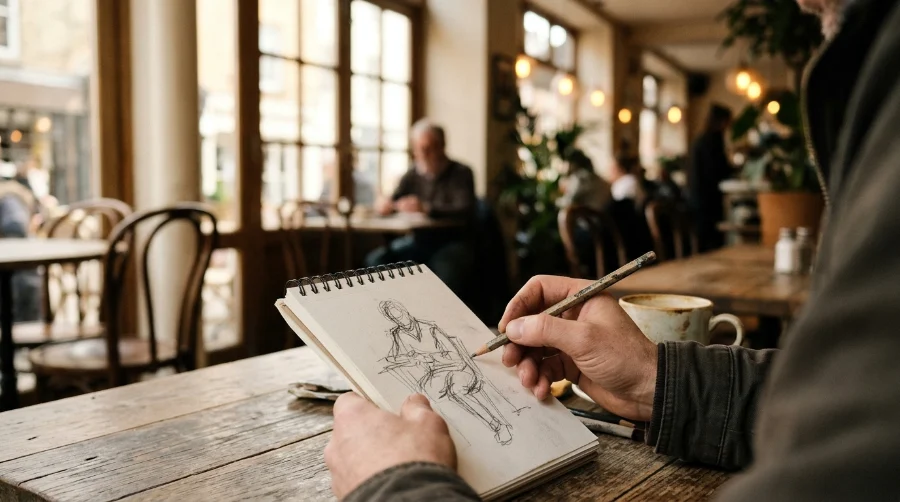
Sketching Strangers in Public Without Making Anyone Uncomfortable

Drawing strangers is the part of figure drawing that beginners put off longest, usually because they imagine the people they draw will notice, react, or mind. In…

Sketching Strangers in Public Without Making Anyone Uncomfortable
Sketching Strangers in Public Without Making Anyone Uncomfortable — the idea behind the technique, and where beginners usually go wrong.

Drawing strangers is the part of figure drawing that beginners put off longest, usually because they imagine the people they draw will notice, react, or mind. In practice, most people do not notice, and the ones who do are rarely bothered, provided you behave in a way that respects their space.

The skill has two halves: the drawing, and the social part. Both are learnable, and getting the second right makes the first much easier.

Before you start: the social basics

A few habits remove almost all the awkwardness.

  • Sit facing somewhat away from your subject, or at an angle. Someone walking past behind you is far less likely to look at what you are doing than someone walking past in front of you.
  • Keep the sketchbook low, angled so only you can see it. A large book held up like a menu draws attention.
  • Work in short sessions of five to fifteen minutes rather than one long one. Short sessions also produce better sketches.
  • Do not ask permission to look, but do not stare either. Glance, sketch, look away, sketch from memory. This is both more discreet and better drawing practice.
  • Never post or share identifiable likenesses of people without permission, and be careful about the setting too, not just the face.

On the whole, public sketching is unremarkable. Cafes, stations, airports, and parks are full of people drawing, and nobody is looking for a reason to object.

Start with the gesture

The temptation is to draw a face straight away. Resist it for the first few minutes and work at the level of the body.

A gesture is a quick line that captures the spine and the weight of the person: the tilt of the torso, the direction of the shoulders, the angle of the head. Two or three minutes is enough. You are looking for an overall slant and a sense of balance, not an outline.

Some useful things to watch for:

  • The line of the spine and whether the person leans forward, back, or to one side.
  • The shoulder line, which is rarely horizontal.
  • The tilt of the head, which often answers the tilt of the torso.
  • Where the weight sits. A person leaning back on a chair, a person about to stand, a person holding a bag on one side: each has a distinct balance.

Once you have the gesture, add a few contour lines over it: the front of the torso, the line of the arms, the shape of the legs. Five minutes of gesture and five minutes of contour gives you a figure that reads as a person, which is enough for a satisfying sketch.

When the person is stationary

A person sitting still is a different subject from a person walking. They are easier to draw and much easier to draw badly, because the pose is held long enough for you to over-analyze it.

For a seated figure, the useful anchors are:

  1. The head, as a simple oval with a direction, tilted slightly.
  2. The shoulder line and the ribcage as a box or a wedge.
  3. The pelvis as a second, smaller box.
  4. The spine connecting the two, with a curve rather than a straight line.
  5. The limbs as tapered cylinders, drawn only after the masses are in place.

The mistake is drawing the limbs first, because a well-drawn arm sitting next to a badly placed torso looks worse than a loose figure with the masses correct. Get the big geometry right and the limbs will follow.

Drawing people in motion

Walking people are the best subject in public sketching, and the easiest to do badly. The temptation is to follow the figure part by part, which guarantees a broken result because the pose changes with every glance.

The method that works is the one gesture drawing teaches: fix the overall action first, commit to it, then add only the details that stay consistent with it.

  • Capture the action in the first five seconds. A few lines for the leading shoulder, the trailing leg, the direction of the stride.
  • Do not add detail to moving parts. A walking hand is a blur, and drawing it precisely means your figure will look wrong the moment you look up.
  • Keep the dark accents consistent. If you decide the front leg is dark, keep it dark. Contradictions between glances are what make a figure look assembled.
  • Let the drawing be about one thing. A sketch that says "she is walking quickly, hunched into the wind" is more successful than one that tries to record every detail.

How long a sketch should be

Beginners tend to work far too long. A useful framework:

  • Two to five minutes: gesture only, no face.
  • Five to fifteen minutes: gesture plus contour, with a light indication of facial features at most.
  • Twenty minutes and up: you need the person to stay put, and you should be working at a level of detail where you are recording rather than inventing.

A set of fifteen quick sketches in an hour is more useful training than one careful portrait, because it trains the decision-making rather than the rendering. The rendering comes later.

Building a repeat location

The best public sketching happens in a place you return to, because you stop being self-conscious after the second visit. A cafe with good light, a station concourse, a library reading room, a park bench in the afternoon.

Specific things make a location productive:

  • Consistent lighting at the same time of day, so the shadows fall in the same direction.
  • A mix of subjects, including people who sit still for a while.
  • A reason to stay, so you are not obviously waiting for something you cannot get.

Common mistakes

  • Drawing the face first. It is the hardest part, it changes most with movement, and it attracts attention because it takes the longest.
  • Chasing detail across the figure. Working from top to bottom guarantees a broken result. Work in one pass, or by masses.
  • Waiting for a perfect pose. They are rare, and the poses that last are usually the boring ones.
  • Looking at your subject constantly. Look for a few seconds, then look at the paper and draw from memory. The memory is more accurate than you expect.
  • Apologizing or explaining yourself. A brief nod if someone glances is enough. Anything more draws more attention.
  • Blank pages. The most common problem in a sketching session is not ability but not starting. A page with ten gesture lines on it is a page you can build on.

Short exercises

  1. Thirty gestures. One afternoon, thirty people, three minutes each, no faces. Record the lean of each one.
  2. One hand each. Draw only hands for an hour. They are the part of the figure people look at least, and they are the hardest to get right.
  3. The waiting game. Draw the same person for the length of a wait, then draw them again from memory, and compare.
  4. Backward drawings. Draw a figure, then draw it again immediately without looking at the first one. The differences show you what you were actually reading.

Drawing people in public is mostly a matter of deciding that it is normal and then repeating it. The drawing improves on its own schedule, and the discomfort usually disappears within a dozen sessions.

SolvaHub Studio Editors

We teach drawing and painting from the ground up — line and shape, perspective and value, color and pigment, and the practice that turns all of it into skill. Every lesson is written around a real difficulty, tested on real materials, and edited for clarity before it goes live. If something here helps, the contact page is the fastest way to tell us.

sketching peoplepublic sketchinggesture drawing

Keep going

Lessons that pair well with this one.

Sketching Techniques
Sketching Interiors and Room Perspective

Interior sketching has a reputation for being difficult because rooms have a lot of straight lines that all need to meet properly. That is true, and the difficulty…
Sketching Techniques5 min read