Watercolor Painting
Choosing Between Wet-on-Wet and Wet-on-Dry in Watercolor
Almost every choice you make in watercolor comes down to one question: is the surface you are painting onto wet or dry? The two answers produce completely different…
Watercolor has one unforgiving rule: whatever you paint is permanent. There is no way to scrub a wash off a dried sheet, and there is no equivalent of the oil…
Watercolor has one unforgiving rule: whatever you paint is permanent. There is no way to scrub a wash off a dried sheet, and there is no equivalent of the oil painter's palette knife scraping a mistake away. Once a passage dries, the only options are to add to it, to lift color out of it, or to paint over it.
Most watercolor disasters are recoverable. The recovery depends entirely on what kind of mistake it is and how wet the paper was when you made it.
Every problem falls into one of five categories, and the right response is different for each.
Identifying which one you are facing takes five seconds and saves a lot of wasted effort.
If the wash is still moving, act immediately.
For a puddle of water, blot it with a clean dry brush or a folded tissue. Lifting the water with the brush also lifts some pigment, which is often exactly what you want.
For pigment that has drifted where it should not, add more clean water to the intended area and let it flow back. Water carries pigment with it, so a controlled flood can move a color back toward where it belongs.
For a backrun, which is the dark rim that forms when water pushes into a drying wash, put clean water into the center of the run and let it travel outward. This pushes the pigment back into the middle of the shape instead of letting it collect at the edge. The run will smooth out as it dries.
For a wash that is too dark, add water to dilute it and let it spread into the damp area around it. If the paper is nearly dry, rewet the edges first so the new water has somewhere to go.
This is the main recovery tool for watercolor, and it works better than most beginners expect.
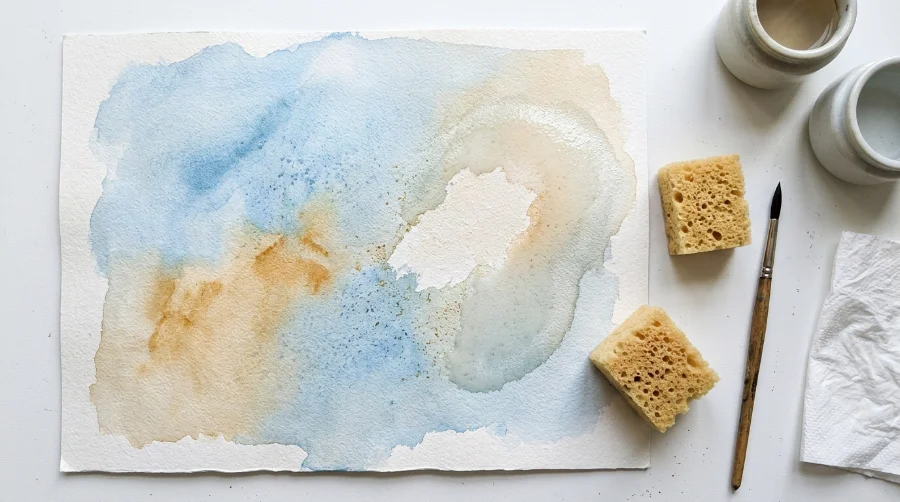
Take a clean, damp brush, use it almost dry, and scrub the area with light circular motions. The damp brush re-wets the paper and picks up pigment, which comes back on the brush. A damp sponge or a piece of damp tissue works similarly.
Three details matter:
Lifting works best on a smooth, hard surface. On a rough, textured paper, the pigment sits down in the valleys of the tooth and does not come out easily, so lifting tends to leave a mottled patch. On cold press paper it works reasonably well if you keep the brush damp rather than wet.
Sometimes a wash has dried too cleanly, with hard edges where you wanted soft ones. Rewetting can soften those edges without removing the color.
Brush clean water over the dried area with a broad, soft brush. Wait until it has soaked in and the paper is evenly damp rather than shiny. Then run a clean damp brush along the edge you want to soften, or drop a small amount of clean water into the area and let it travel. The pigment will migrate and the boundary will soften.
This is also the technique for adjusting a wash that has dried too light in one area and too dark in another. Rather than repainting, equalize the moisture and let the color flow to where you want it.
One caution: rewetting a passage that is already the right value tends to make it slightly lighter and less saturated, because a small amount of pigment lifts every time. Do it once rather than repeatedly.
A cauliflower edge is a lacy, textured rim that forms when a wash meets a damp area and pushes the pigment outward as it dries. It is the most common watermark problem in watercolor.
While the wash is still damp, place a sheet of clean absorbent paper against the edge and press lightly. The paper draws the excess water out of the boundary and the edge dries flat. If the wash has already dried with the rim, you can soften it by rewetting the edge very slightly and immediately blotting with clean paper, which lifts the concentrated pigment line.
Prevention is easier than repair. Before painting a large wash, either let the paper dry completely or lay down an even dampness across the whole area, and keep a clean sheet of absorbent paper nearby for any edge you can reach in time.
Lifting always costs something: pigment, paper texture, and time. In some cases the fastest fix is to repaint the passage.
This works when the wrong color is close enough in value to the correct one that the difference can be covered, and when the area is a large flat passage where a fresh wash will sit cleanly over the old one. It fails when the new wash is lighter than the old one, because watercolor cannot lighten anything, and when the paper is badly textured or already carries a lot of layered paint, because the new layer will look like a patch.
The most reliable version of painting over is to glaze: apply a transparent color over the mistake. A glaze of a complementary color shifts the wrong hue toward the right one without touching the paper's structure, and it keeps the passage luminous instead of making it into an opaque spot.
Sometimes the mistake is not local but structural: the value structure is inverted, the light source is confused, or the whole passage is at the wrong level of contrast. These are harder and often cannot be repaired.
A few options remain.
Almost every rescue would have been unnecessary with a few routine precautions.
Learning to fix watercolor mistakes is not a lesser skill than learning to paint cleanly. Every experienced painter makes the same handful of errors regularly and simply knows the recovery for each one, which is why their work does not show the accidents.
Lessons that pair well with this one.
Almost every choice you make in watercolor comes down to one question: is the surface you are painting onto wet or dry? The two answers produce completely different…
Water is the easiest subject to paint badly and one of the hardest to paint well. The reason is that we expect water to be a color, and it is not. A wave is a shape…
A painted sky is mostly gradient. The whole upper half of a landscape painting is a transition from one color to another, and the transition has to be seamless or…