Watercolor Painting
Choosing Between Wet-on-Wet and Wet-on-Dry in Watercolor
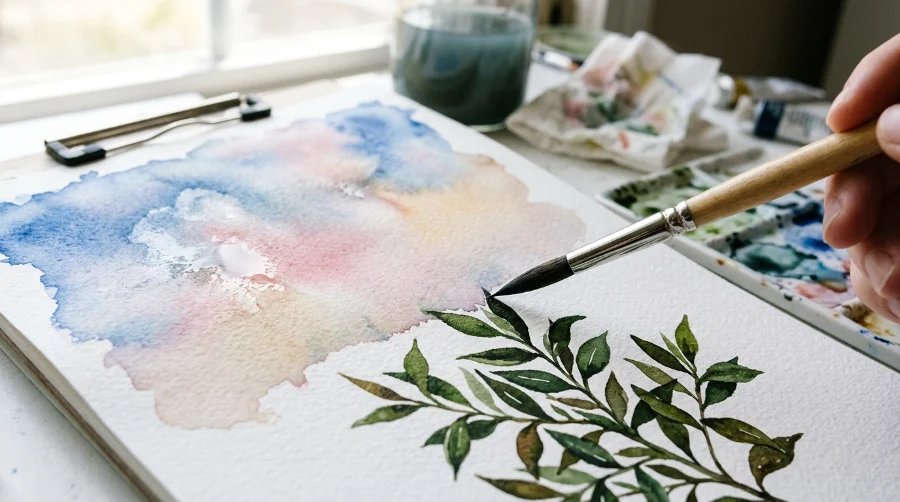
Almost every choice you make in watercolor comes down to one question: is the surface you are painting onto wet or dry? The two answers produce completely different…
Some watercolor paints settle into the valleys of rough paper and leave a grainy, speckled texture that you did not paint. Other colors sit on the surface as smooth…
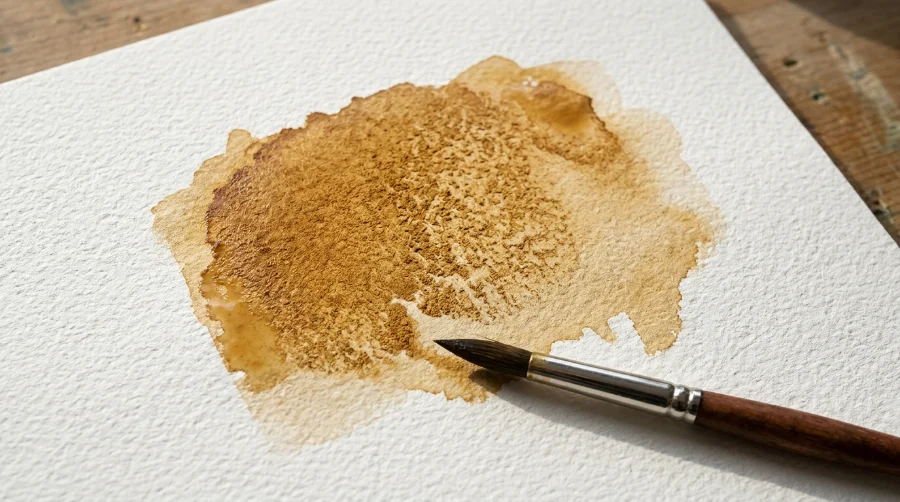
Some watercolor paints settle into the valleys of rough paper and leave a grainy, speckled texture that you did not paint. Other colors sit on the surface as smooth and flat as ink. Both behaviors are granulation, and they are properties of the pigment rather than of your technique.
Understanding it changes how you choose colors, and it can rescue a painting that has already gone blotchy.
Granulation happens when pigment particles are large and heavy enough to separate from the water and settle into the dips of the paper surface. The heavier particles drop first, and they gather in the texture of the sheet.
Several properties of a pigment determine how strongly it granulates.
The general rule holds: earth pigments such as raw sienna, yellow ochre, and burnt sienna granulate strongly, because they are dense and made of large particles. Many modern organic pigments granulate little, though some do.
The most useful test is the simplest one, and it takes ten seconds.
A drop test works as well. Place a drop of heavy pigment mixture on the surface of a damp sheet and let it run. Colors that granulate will visibly separate, with the heavy particles dropping ahead of the water and leaving a speckled trail.
Granulation is not a defect. It is one of the things that makes watercolor look like watercolor, and it is genuinely beautiful in the right passages.
For these uses, let the paint do its work. Fighting the granulation by adding more water usually makes it worse, because more water means more travel and more separation.
When granulation appears where you did not want it, there are a few approaches.
Granulating colors behave differently when glazed. A layer of a granulating color over a dry wash settles onto the surface of the layer below rather than merging with it, which creates a visible separation between the layers.
That is a problem when you want a smooth transition, because you will see the boundary of each glaze rather than a continuous shift. It is an advantage when you want texture, because it creates visible layers that read as different materials or different moments.
Grays mixed from granulating earth pigments are a common source of frustration in landscapes. A beautiful soft gray wash will suddenly develop a sandy texture once it dries, and the fix is usually to add a small amount of a smooth pigment or a drop of ox gall to the mixture before painting.
The same physics show up in other media, and recognizing it helps.
If you work across several media, this is one place where the behavior of a single pigment stays consistent, which makes it easier to transfer color knowledge between them.
Granulation is one of those effects that looks like a mistake until you know what it is and how to direct it. Once you have tested your own palette, you will know which colors to reach for when you want texture and which to keep away from the passages you want smooth.
Lessons that pair well with this one.
Almost every choice you make in watercolor comes down to one question: is the surface you are painting onto wet or dry? The two answers produce completely different…
Water is the easiest subject to paint badly and one of the hardest to paint well. The reason is that we expect water to be a color, and it is not. A wave is a shape…
A painted sky is mostly gradient. The whole upper half of a landscape painting is a transition from one color to another, and the transition has to be seamless or…