Art Materials
Drawing With Ink and Pen Tools and Techniques
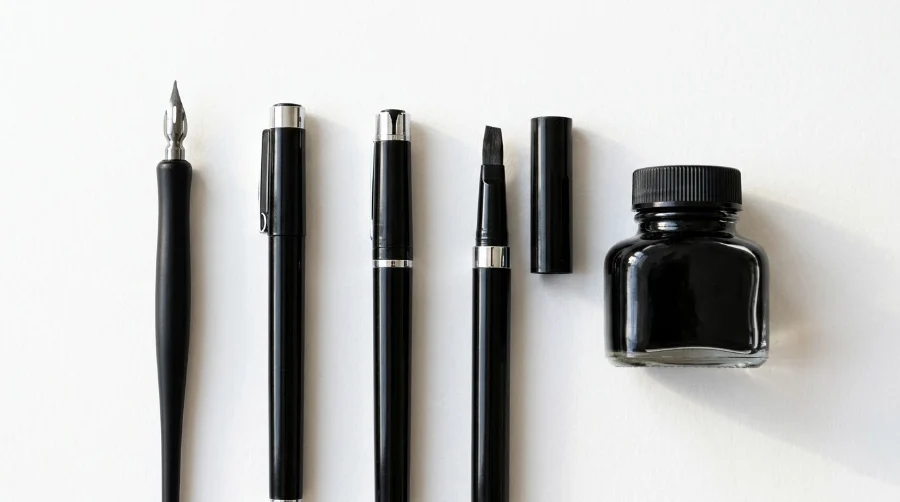
Choosing a pen sounds trivial, since any of them will put a line on paper. It is not trivial, because the pen determines what kind of line you can make, how fast…
Almost every beginner owns a box of pencils and has no idea what the numbers on them mean. What they discover quickly is that the very soft pencils smudge, the very…
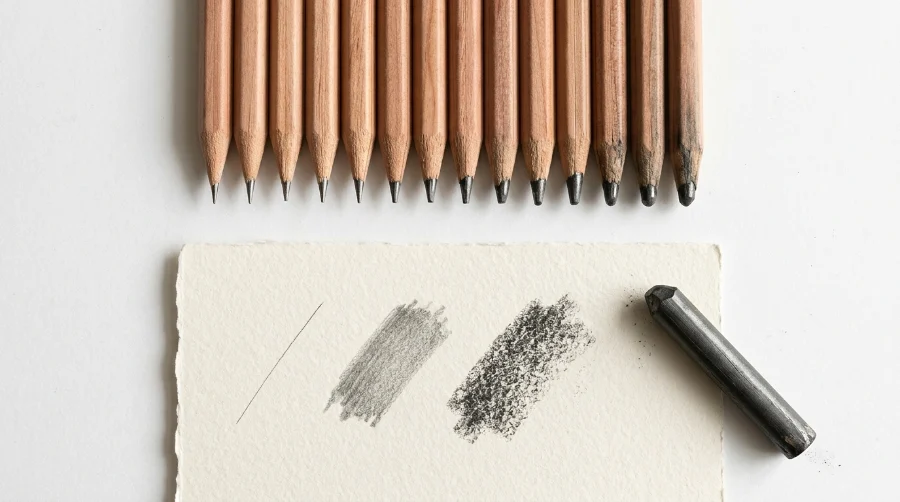
Almost every beginner owns a box of pencils and has no idea what the numbers on them mean. What they discover quickly is that the very soft pencils smudge, the very hard pencils are nearly impossible to see, and the middle grades are the only ones that seem to do anything. A little understanding of what the grades actually control makes the whole material set make sense.
There are two numbers on a pencil, and they do different jobs.
The letter indicates the grade. H stands for hardness and B for blackness. In the middle of the range you will find HB, which is the standard writing pencil.
Moving from H toward the hard end, the graphite is harder and produces a lighter, finer, more precise line. Moving from B toward the soft end, the graphite is softer and produces a darker, more textured, more smudgable line.
The scale runs from about 9H at the hard end to 9B at the soft end, with HB in the middle. The common grades and how they behave are roughly as follows.
The grading is not perfectly consistent between manufacturers, so a 2B from one brand may behave differently from a 2B from another. Buying a few brands to compare is more useful than memorizing the numbers.
The reason to own a range is that a single pencil cannot produce both a fine, crisp line and a deep, textured dark.
Hard pencils hold their point well and cut a clean line. They are the right choice for hatching, cross-hatching, contour lines, and any drawing where the structure needs to be visible. Their drawback is that they produce very little value range, so you cannot make a truly dark mark without pressing hard enough to gouge the paper.
Soft pencils produce a wide tonal range but their points wear down quickly and they smudge easily. They are the right choice for shading, dark accents, and loose expressive work.
A drawing made with one pencil will show that limitation. A drawing made with three or four grades reads as much more considered, because the artist chose the material for each passage rather than forcing one tool to do everything.
Graphite pencils are made from a mixture of graphite and clay, and the proportions are what create the grades. Clay is what makes the mark lighter and harder, and graphite is what makes it dark and soft.
Black core pencils use a higher proportion of graphite, so they give more saturation and a slightly grittier line. Most artist-grade drawing pencils are black core.
Light core pencils contain more clay, giving a smoother, more uniform, slightly more transparent line. They tend to blend more easily and to look more like a written line.
The difference matters if you work in a very tonal, blended style, where the light core's smoothness is an advantage.
A pencil's rating assumes a standard paper. The same pencil behaves very differently on different surfaces.
You can also buy artist-grade graphite in sticks, which have no wood casing. They are used for broad washes of tone, for filling large dark areas, and for drawing with a side. A stick of 6B or 8B is one of the most useful things in a beginner's kit, because it produces a deep, even dark that a pencil cannot.
Charcoal is not graphite, though it is often sold alongside it. It is much blacker, softer, and more fragile, and it comes in three forms.
Conté crayon comes in sticks of compressed pigment and produces a dense, buttery dark line with very fine control. It is a good complement to charcoal because it does not smudge easily and holds a sharp point.
Charcoal and conte both need a workable surface with tooth, and they smear on anything smooth. Both are also fragile, so keep them in a flat case rather than rolling them in a pocket.
You do not need thirty pencils. This covers almost everything:
Add paper before you add more pencils. A pack of medium tooth drawing paper will improve your work more than any additional grade, because the graphite has to have something to catch on in order to do what it is capable of.
Lessons that pair well with this one.
Choosing a pen sounds trivial, since any of them will put a line on paper. It is not trivial, because the pen determines what kind of line you can make, how fast…
Paper is the one material in a drawing or painting that most people choose by accident. They use whatever is in the sketchbook they happen to own, or the cheapest…
Charcoal and pastel are the two soft drawing media, and they are often treated as variations of the same idea. They behave very differently, and choosing correctly…