Charcoal and pastel are the two soft drawing media, and they are often treated as variations of the same idea. They behave very differently, and choosing correctly…
S SolvaHub Studio EditorsPublished July 26, 20266 min read1,275 words
Pastel and Charcoal Soft Drawing Media Compared — the idea behind the technique, and where beginners usually go wrong.
Charcoal and pastel are the two soft drawing media, and they are often treated as variations of the same idea. They behave very differently, and choosing correctly between them is mostly a matter of what you want the finished drawing to be made of. Charcoal is dust. Pastel is pigment bound in a stick.
Charcoal
Charcoal is burnt organic material, traditionally willow, and it is available as natural sticks, compressed sticks, and charcoal pencils.
Natural charcoal is soft, dusty, and loose. It smears easily, lifts off with an eraser, and gives very little line control. It is the best charcoal for broad tonal work and for fixing mistakes.
Compressed charcoal is powdered charcoal pressed with gum or clay into a hard stick. It holds a line, marks a clean edge, and is dark enough to work into deep blacks. This is the most useful form for most people.
Charcoal pencils give precise lines and are controlled enough for detailed work, and they also blend well.
Charcoal is fast, forgiving, and produces dramatic value range. It is also fragile, dusty, and impossible to fix after the fact without a spray, so it suits studies, gesture work, and large expressive drawings better than small finished pieces.
Pastel
Pastel is pigment ground in a non oily binder. The binder holds the pigment together in a stick, but the surface is still completely dry to the touch, which is why pastel dust transfers onto everything.
Soft pastel has a high proportion of pigment and very little binder. It is the most expressive of the drawing media, capable of rich color and velvety blending, and it is extremely fragile.
Semi hard pastel has more binder and holds a sharper line while still blending.
Hard pastel is closer to a chalk and can take fine detail and light lines.
Oil pastel uses an oil binder. It is a different material entirely: it is oily, it can be applied thickly, and it does not smudge like a dry pastel.
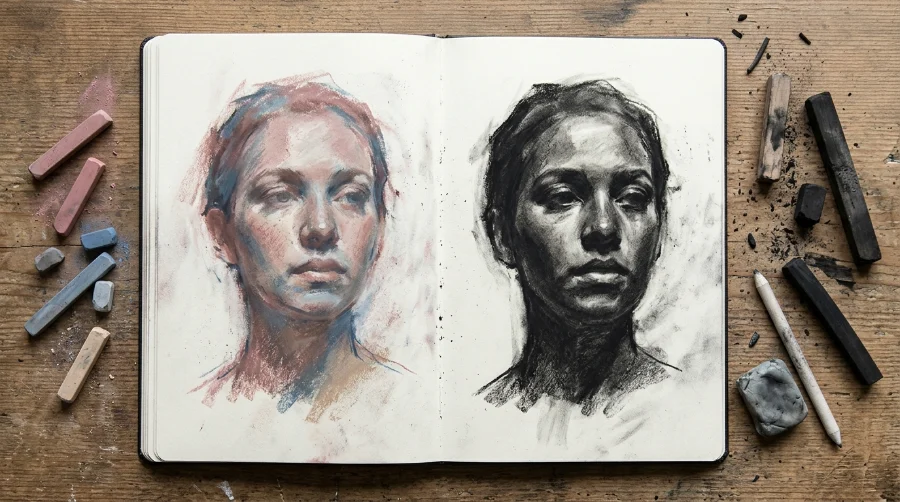
Pastel is the only dry medium that combines color with the softness of charcoal. It is the natural choice for portraits, animals, still life, and anything where skin or fur needs to be blended.
Side by side
Line control. Charcoal wins easily, especially with compressed charcoal and charcoal pencils. Pastel at its softest is almost incapable of a controlled thin line.
Blending. Pastel blends more smoothly because the pigment is bound in a stick and transfers in a controlled way. Charcoal blends but tends to look dusty and granular.
Color. Pastel is a color medium and charcoal essentially is not. This is the single biggest difference.
Value range. Charcoal reaches a true deep black more easily. Pastel at the darks goes to a dark brown or a deep saturated color, which is often more useful.
Forgiveness. Charcoal lifts off a kneaded eraser easily, so mistakes can be removed. Pastel mistakes have to be painted over, which is easier in a colored medium anyway.
Durability. Neither is durable without protection. Pastel smudges from any contact. Charcoal is more fragile in a different way, since it abrades when rubbed against other surfaces.
Paper. Both need a tooth. Smoother paper will not hold them, and very rough paper will fragment the stick. Pastel suits a slightly rougher surface than charcoal because the pigment has more body.
Making a choice between them
There is a practical way to decide which medium to reach for, based on what the finished drawing has to do.
Choose charcoal when the drawing needs to be fast, dramatic, and correctable, such as a gesture study, a value exercise, or a large expressive piece.
Choose pastel when the drawing needs to carry color, soft edges, and a sense of surface, such as a portrait, an animal study, or a still life.
Choose pastel when you are drawn to the medium itself, since its physical qualities are hard to get anywhere else and the resistance of the paper is part of the pleasure.
Choose charcoal when the budget is a factor, since a block of charcoal costs very little and lasts a long time.
Many artists keep both for exactly this reason. There is no rule that a drawing has to stay in one medium, and the best results often come from a charcoal underdrawing finished in pastel.
Combining the two
Using charcoal first and pastel over it is a reliable combination, and it works because the two media have complementary strengths.
Block the composition in compressed charcoal and fix the value structure, since charcoal is fast and easy to correct.
Draw the darks and the mid tones with a soft charcoal, and leave the lights as untouched paper.
Cover the drawing with a sheet of glassine or trace paper and burnish it gently, which prevents the charcoal dust from migrating into the pastel layers.
Apply pastel over the fixed drawing, working from the mid tones to the darks and saving the brightest accents for last.
Return to the charcoal with a soft pencil or a piece of compressed charcoal for the deepest accents, which gives them a softness the pastel cannot produce.
The order matters. Charcoal dust that gets into a pastel layer will gray it, and pastel applied to an unfixed charcoal drawing will lift the charcoal off the paper when you blend.
Handling each medium
Charcoal practice:
Fix your paper to a board with masking tape or a drawing border, because the medium transfers onto everything it touches.
Work from the light end. Establish the lights, then build mid tones, then add the darks last.
Use a blending stump or a soft brush for the mid tones, and a kneaded eraser to lift highlights back out.
Keep a piece of scrap paper to wipe the brush and the hands.
Pastel practice:
Work on a firm surface with a rigid backing so the paper does not buckle.
Build up color in layers rather than trying to mix on the surface. Pastel does not blend like paint, it layers.
Use a soft cloth or a brush to blend, and a sharp point for the final accents.
Rotate the pastel frequently so the sides do not become rounded.
Finish the drawing with an opaque medium such as ink or a fine brush if you want it to survive handling.
Common mistakes
Using charcoal on smooth paper. It will not grip and the dust will not adhere.
Smudging charcoal with a finger and then wondering why the drawing feels greasy. Use a brush or a stump.
Expecting pastel to be erasable. It is not, in the way that graphite is not either.
Blending pastel too early. Once you blend, the surface becomes smooth and the next layer will not grip.
Mixing pastel and charcoal on the same sheet without a fixative. The charcoal dust will sit on the pastel and gray it.
Framing pastel without protection. Glass and mat will hold the dust against the surface.
Exercises
Same subject, same value study, once in compressed charcoal and once in soft pastel.
Line test. Draw a graded scale from hairline to solid in each medium and compare the results.
Blend test. Make a large soft patch in each medium and compare the surface.
Limited color. Complete a small portrait using three pastels only, mixing on a separate piece of paper and using it as a guide.
If you are drawn to dramatic darks, fast correction, and broad expressive marks, charcoal suits you. If you are drawn to color, soft blending, and rich surfaces, pastel does. Trying both for a month is the fastest way to find out which one you actually prefer to work in.
S
SolvaHub Studio Editors
We teach drawing and painting from the ground up — line and shape, perspective and value, color and pigment, and the practice that turns all of it into skill. Every lesson is written around a real difficulty, tested on real materials, and edited for clarity before it goes live. If something here helps, the contact page is the fastest way to tell us.
Choosing a pen sounds trivial, since any of them will put a line on paper. It is not trivial, because the pen determines what kind of line you can make, how fast…
Almost every beginner owns a box of pencils and has no idea what the numbers on them mean. What they discover quickly is that the very soft pencils smudge, the very…
Paper is the one material in a drawing or painting that most people choose by accident. They use whatever is in the sketchbook they happen to own, or the cheapest…