Art Materials
Drawing With Ink and Pen Tools and Techniques
Choosing a pen sounds trivial, since any of them will put a line on paper. It is not trivial, because the pen determines what kind of line you can make, how fast…
Acrylic, gouache, and watercolor are all water-based paints, and beginners often treat them as interchangeable versions of the same thing with different prices…
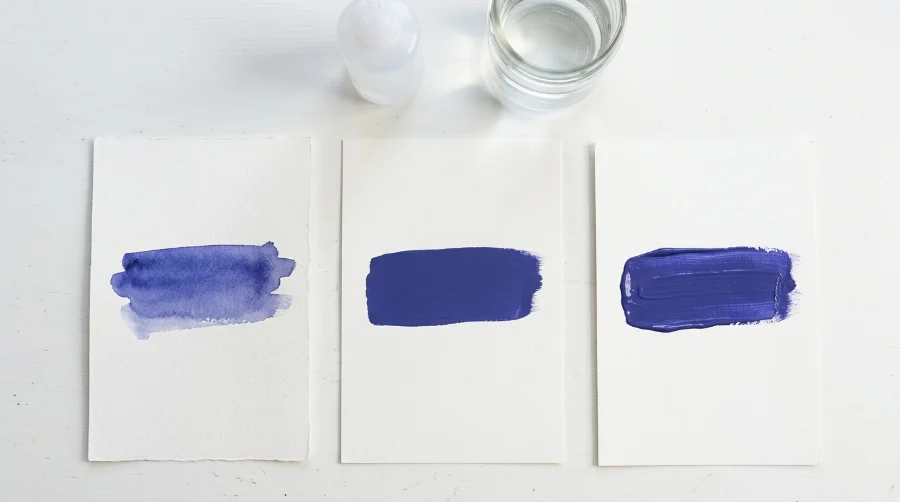
Acrylic, gouache, and watercolor are all water-based paints, and beginners often treat them as interchangeable versions of the same thing with different prices. They are not. They differ in how transparent they are, how much they cover, how fast they dry, whether they can be reactivated once dry, and how they behave on different papers. Choosing the wrong one for a job is one of the most common reasons a painting goes wrong in ways that are hard to diagnose, because the paint is fighting the technique rather than supporting it.
Here is how each of the three behaves, and what that means in practice.
Watercolor is transparent. Pigment suspended in gum arabic settles into the paper's surface, and light passes through the wash to the white of the sheet. This is why the whitest highlights in watercolor are bare paper, and why no amount of white paint will produce the same effect.
Gouache is made with the same binder as watercolor plus an additional opaque ingredient. It can be mixed thinner to become semi-transparent, but at normal consistency it covers the surface beneath it. The white of the paper plays almost no role, so the lightest value must be mixed with white.
Acrylic sits between the two, and its opacity varies by pigment. Some modern acrylics are quite transparent, some are heavily body color. The practical difference is that acrylic covers reliably in a single layer, which makes it forgiving for beginners and quick for anyone painting opaquely.
Coverage is the ability to hide what is underneath. It follows from opacity but is not identical to it, because a transparent color can still knock back a lighter color underneath while still letting it influence the result.
Watercolor dries by evaporation of the water. Drying time varies enormously with paper, humidity, and how much water was used, but a thin wash on absorbent paper is usually workable within a minute or two. The paper itself absorbs some of the water, so the sheet can be damp in a way that is not obvious from the surface.
Once fully dry, watercolor is permanent and reactivated only by water. The dried film is matte and sits within the sheet rather than on it.
Gouache dries faster than watercolor because of the added opaque component, and the surface becomes matte and slightly chalky. It is still water-soluble, so a light touch of water will soften it, though it does not return to a workable state as readily as a fresh wash.
Because gouache is opaque, a misapplied stroke will hide what was beneath it, but you can also correct it by painting over it. That property makes gouache forgiving in a way that watercolor is not.
Acrylic dries by evaporation and then forms a continuous plastic film. On a warm day it can be touch-dry in a minute and fully cured within a day or two. Drying is significantly faster than either of the others, and this is the single most important practical difference for a beginner.
Two consequences follow. First, acrylic cannot be reactivated with water once dry, so corrections must happen while the paint is still wet, which means working quickly and mixing colors in adequate quantity rather than dabbing repeatedly. Second, thick applications can form a slightly rubbery surface, and very heavy layers may crack if they are applied in one pass rather than built up in two or three.
This is where the three separate most clearly.
Edges behave differently in each medium because of drying speed and transparency.
Watercolor gives the most control over soft edges, and also the least tolerance. Because the paint is transparent and the paper takes pigment quickly, a soft edge must be created deliberately, by working into damp paper, while a hard edge is created by letting the wash dry first and then placing a wet stroke against it. Both are reliable, and both are unforgiving of a misjudged timing.
Gouache behaves similarly while wet but dries more quickly, so the window for merging edges is shorter. Its opacity means a hard edge can also be produced simply by painting over the edge with a pale mix, which is more forgiving than in watercolor.
Acrylic is the most forgiving for hard edges because the paint covers, and the least forgiving for soft ones. Blending acrylic edges requires working both areas while both are wet, and the short drying time makes this a matter of speed. A soft-edged acrylic passage often requires deliberately slowing the drying, which is why painters sometimes keep a separate water brush at hand.
Watercolor needs absorbent paper. The pigment has to sink into the sheet, and a smooth surface will not hold it well. Sizing matters too: an unsized sheet absorbs water rapidly and produces softer, more diffuse washes than a sized sheet, and it buckles more readily.
Gouache works on a wider range of surfaces because it does not need to sink in. It performs well on both absorbent and relatively non-absorbent paper, and on board. On very absorbent paper it can look flat because the opaque particles get dragged into the texture.
Acrylic is the least demanding about paper. It sits on the surface and covers, so it works on most drawing paper, board, and canvas. The main caution is that very absorbent or soft paper can let the paint grip and dry with a slightly rough texture, and a slick surface will not hold heavy impasto layers.
Choose watercolor when you want luminous transparent washes, when the whiteness of the paper is part of the image, or when you are painting light effects and skies.
Choose gouache when you want reliable coverage, when you need to paint light over dark, or when you want an illustration that holds its colors with minimal layering.
Choose acrylic when you want to work fast, build up layers, cover mistakes, or move between paper and canvas without changing behavior.
None of the three is more correct than the others. Each behaves in a particular way, and much of the skill in using a paint is knowing which of those ways your painting actually needs.
Lessons that pair well with this one.
Choosing a pen sounds trivial, since any of them will put a line on paper. It is not trivial, because the pen determines what kind of line you can make, how fast…
Almost every beginner owns a box of pencils and has no idea what the numbers on them mean. What they discover quickly is that the very soft pencils smudge, the very…
Paper is the one material in a drawing or painting that most people choose by accident. They use whatever is in the sketchbook they happen to own, or the cheapest…